In May, Expats.cz ran a piece on why concert tickets in Czechia keep getting more expensive. Prices up roughly 33% in seven years. Organiser commissions now commonly around 8%. The buyer's booking fee moved from a flat 15 crowns to 3.5% of the ticket. Government cultural subsidies down. And GoOut, Ticketportal and Ticketstream all merged under the Estonian group PLG.
The most useful line in the article comes from Lukáš Jandač, who runs PLG in the Czech Republic:
"I think it's healing the market, because the competition that was here, we were giving out super low commissions. That system wasn't sustainable in the long term."
He is not being evasive. He is telling you, plainly, that low commissions were the problem and that the cure is fewer of them. From his side of the table that is a reasonable thing to say. From yours, "healing the market" means your cost base goes up and there is no competitor left to pull it back down. The competition office declined to intervene.
I want to talk about what a business does with information like that, because the instinct most people have is the wrong one.
The reflex, and the better question
When fees rise, the reflex is to shop. You compare platforms, find the one charging a point less, migrate, and feel like you did something. Six months later the market has consolidated again and you are back where you started, having spent the migration effort for nothing.
The reflex treats the fee as bad luck: something that happens to you, that you can only react to. The quote above shows it is nothing of the kind. Someone chose it, on purpose, and your business is where the money comes from.
The better question is not which platform is cheapest. It is what am I actually buying, and do I need it?
A ticketing platform sells you three things bundled together: a way to take money, a way to deliver and validate tickets, and discovery — placement in front of people browsing for something to do. The first two are ordinary infrastructure. The third is genuinely valuable and genuinely hard to replicate.
So the question resolves to something a business owner can actually answer: where do my customers come from? If they find you by browsing a ticketing app, you are buying discovery and the percentage is a marketing cost. If they come from your own audience — your list, your Instagram, people who came last time and told a friend — then you are paying a percentage of every sale for a service you are not using, and you have been for years.
That is not a technology question. Nobody needs to know what a webhook is to answer it.
What Mesaa decided
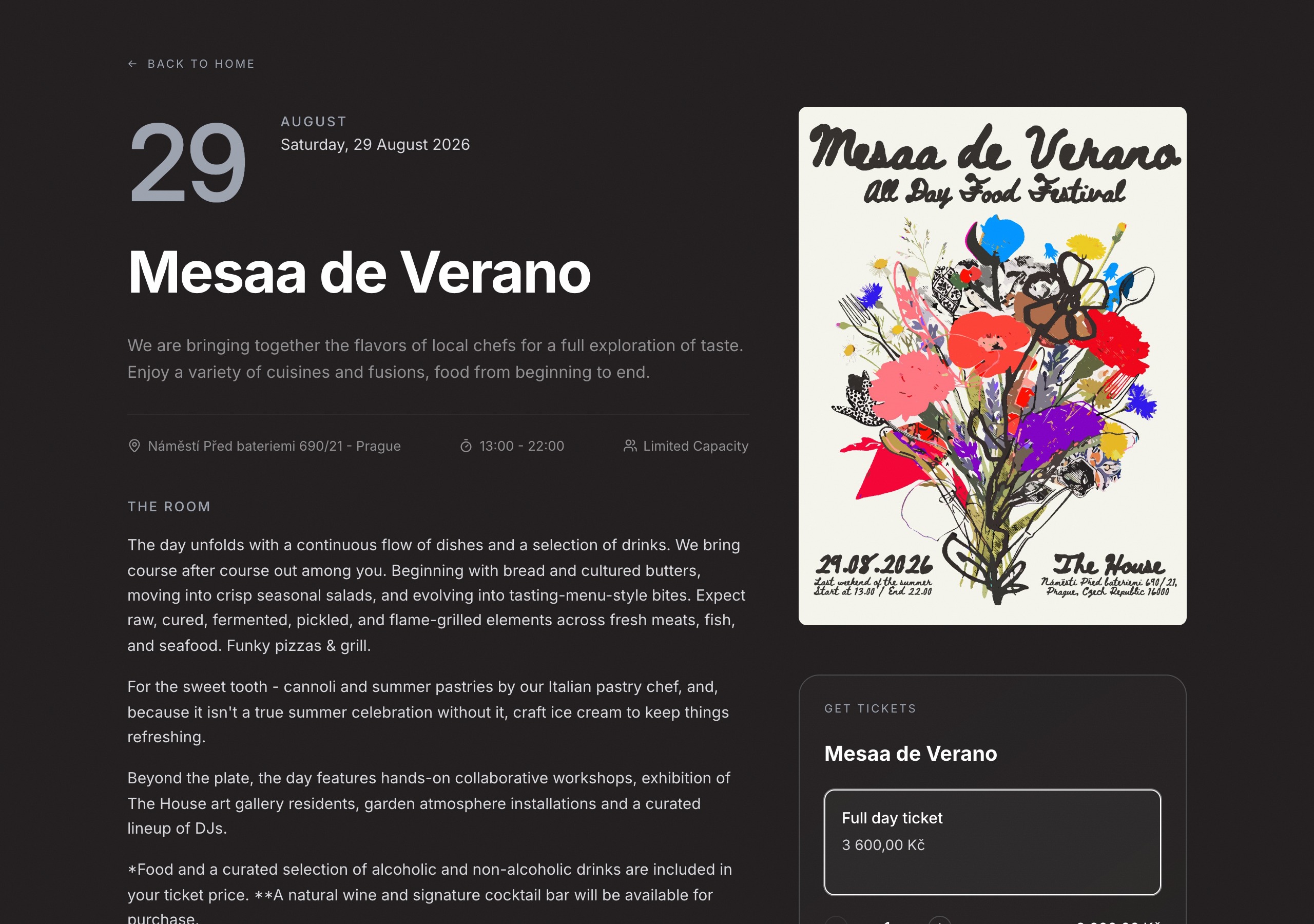
Mesaa is a Prague fine dining experience. Several times a year they bring together local chefs, artists and DJs around one long table — seasonal dishes, natural drinks, music, from afternoon into the night. No fixed venue, no fixed menu. Each edition is built from scratch around a place and a season. They also design private dinners and brand activations around food.
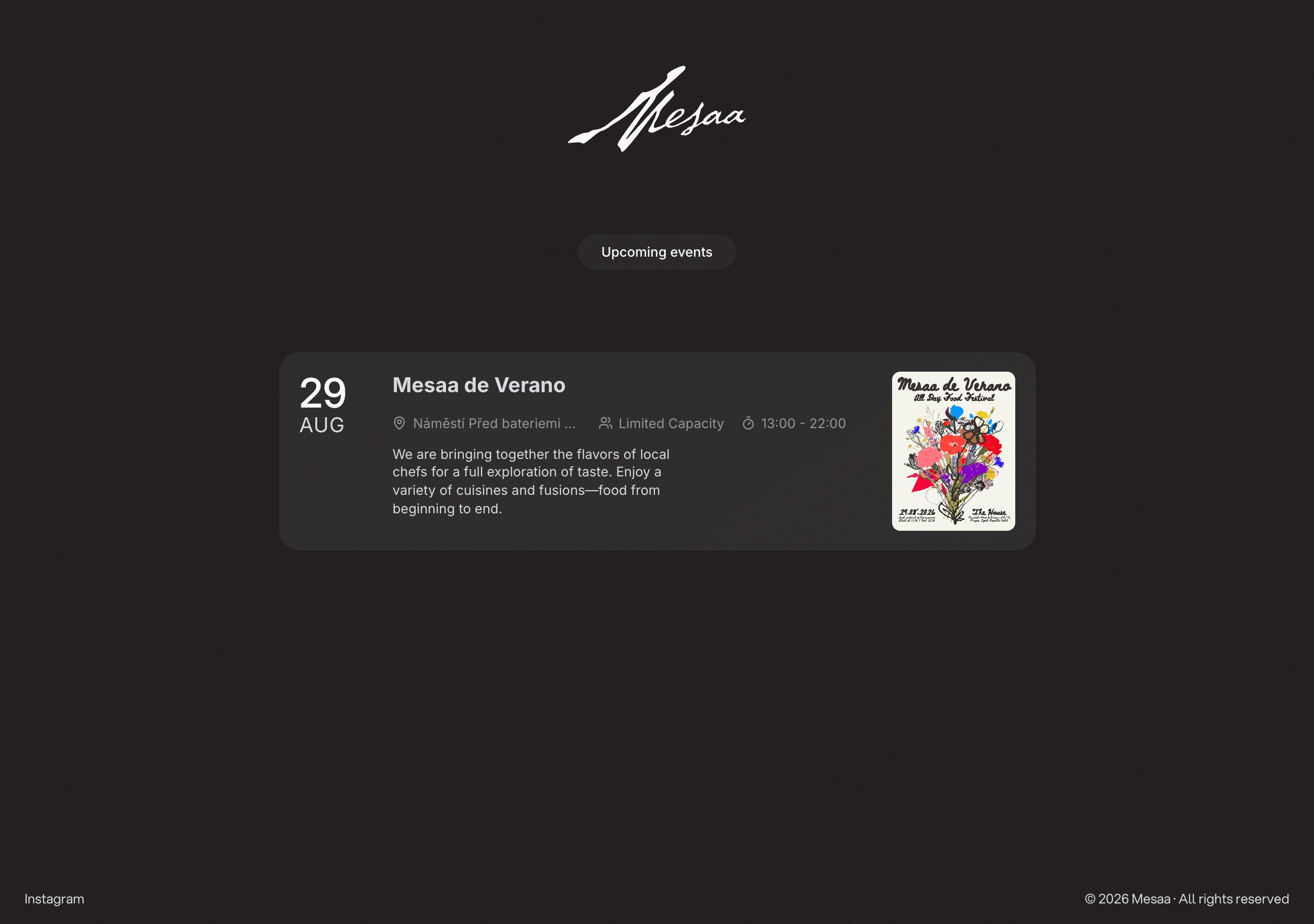
They were starting from zero, which makes their case cleaner than most. They had no platform to escape from. They had a choice to make: enrol, or not.
The default was GoOut. In Prague that is simply where an event goes. And the case for it is real — it is the reflex for a reason, and for a promoter who depends on strangers discovering their night, it earns its cut.
But Mesaa's guests do not come from browsing. A long table for a few dozen people, several times a year, sold to an audience that follows them — that is the opposite of a discovery problem. What they needed was narrower and more specific:
- Sell seats in advance, so the kitchen knows what to buy
- Know exactly who is coming, and be able to reach them
- Cap seats per booking, because a table has a fixed number of chairs and one buyer taking eight of them changes the whole evening
- Present the evening as the thing they had designed — the menu, the chefs, the collaborators — rather than as a listing in someone else's grid
- Look like Mesaa from the first click to the ticket in your inbox
Read that list again. Almost none of it is what a ticketing platform is optimised for, and two items on it — the seat cap and the menu — a general-purpose platform actively gets wrong, because it was built for a room with a capacity number rather than a table with places at it.
They were being asked to hand over roughly a tenth of every seat, forever, for something that fitted them badly in both directions.
The part that changed recently
Here is what makes this decision different from the same decision three years ago.
The alternative used to be expensive. Building your own ticketing meant a long agency engagement, a five-figure budget and a maintenance dependency — which is why, for a business Mesaa's size, the platform fee was obviously the cheaper option no matter how badly it fit.
That is no longer true, and the reason is boring: the hard parts have already been built. I built a full ticketing system last year for a Prague music collective — payments, tickets, door check-in, an admin panel their team runs themselves. It has been handling real money since April. Mesaa runs on that same system, set up for them, in their brand, on their accounts.
The first build took five weeks. Mesaa's took two.
That gap is the whole business story. When the cost of the alternative falls by more than half, the alternative stops being reserved for companies bleeding serious money to fees, and becomes available to the ones who have not started bleeding yet. The decision moves from escape this later to never sign up for it.
What they got for it
Not features — outcomes:
A much smaller cut, and a clear one. I should be straight about my own model here, because it matters to the argument: I charge a flat 3% of ticket sales to run and support the system, on top of a setup fee. Card processing is separate — that is what accepting money costs anywhere. So Mesaa did not go from a percentage to nothing. They went from roughly a tenth of the ticket to three per cent, and they can see exactly what that three per cent is for. Their hosting sits in free tiers at this volume and rises into the tens of euros a month, not the thousands, as they grow.
The customer relationship. They know who bought, they can reach them, and nobody else is sitting between them and their own guests.
Their own experience end to end. The event page, the ticket in the buyer's inbox, the check-in at the door — all of it looks like Mesaa, because it is Mesaa's.
No exposure to somebody else's consolidation strategy. The next merger, the next commission adjustment, the next "healing the market" quote — none of it reaches their P&L. Their rate is in a contract with one person who has to keep earning it. That is worth more than the percentage saved, and it is the part that never shows up in a fee comparison.
The pattern, beyond ticketing
I do this work — building the alternative when the standard option stops fitting — and the ticketing case is the easiest one to see. But the shape repeats everywhere: a scheduling platform taking a cut of every session, a marketplace taking a cut of every order, a SaaS layer priced as a share of your revenue in a category that has quietly stopped competing on price.
Four questions tell you whether it is worth a serious look:
- How big is the cut, and what does it buy? A percentage is not automatically bad — it is bad when it is large and you cannot say what it pays for. Write down your rate, then write down what you actually get for it. If the second list is short, you have your answer.
- Are you using the expensive part? Most platforms bundle infrastructure with distribution. If you are only using the infrastructure, you are paying marketplace rates for plumbing.
- Is your market consolidating? If your suppliers are merging and the regulator is standing back, the fee is going one direction. Plan for the trend, not today's rate.
- Does the tool fit, or have you adapted to it? Every workaround your team performs weekly is a cost you have stopped noticing.
If the answer to all four points the same way, the conversation is worth having. If it doesn't, stay where you are — a platform that fits and earns its percentage is a good deal, and I will say so on a call rather than sell you something you don't need.
That is the same question I ask in every project, whether the answer turns out to be a ticketing system or an agent that quietly does a job nobody should be doing by hand: what are you actually paying for, and does it match what you actually need?
If you sell tickets, seats or sessions and that question has been nagging at you, here's how the ticketing system works, including what it costs — or book a call and bring your numbers. Thirty minutes is enough to know whether the maths works for you.
Fee figures cited above: Expats.cz on Czech ticketing consolidation and Euro.cz on platform margins. Correct as of August 2026.